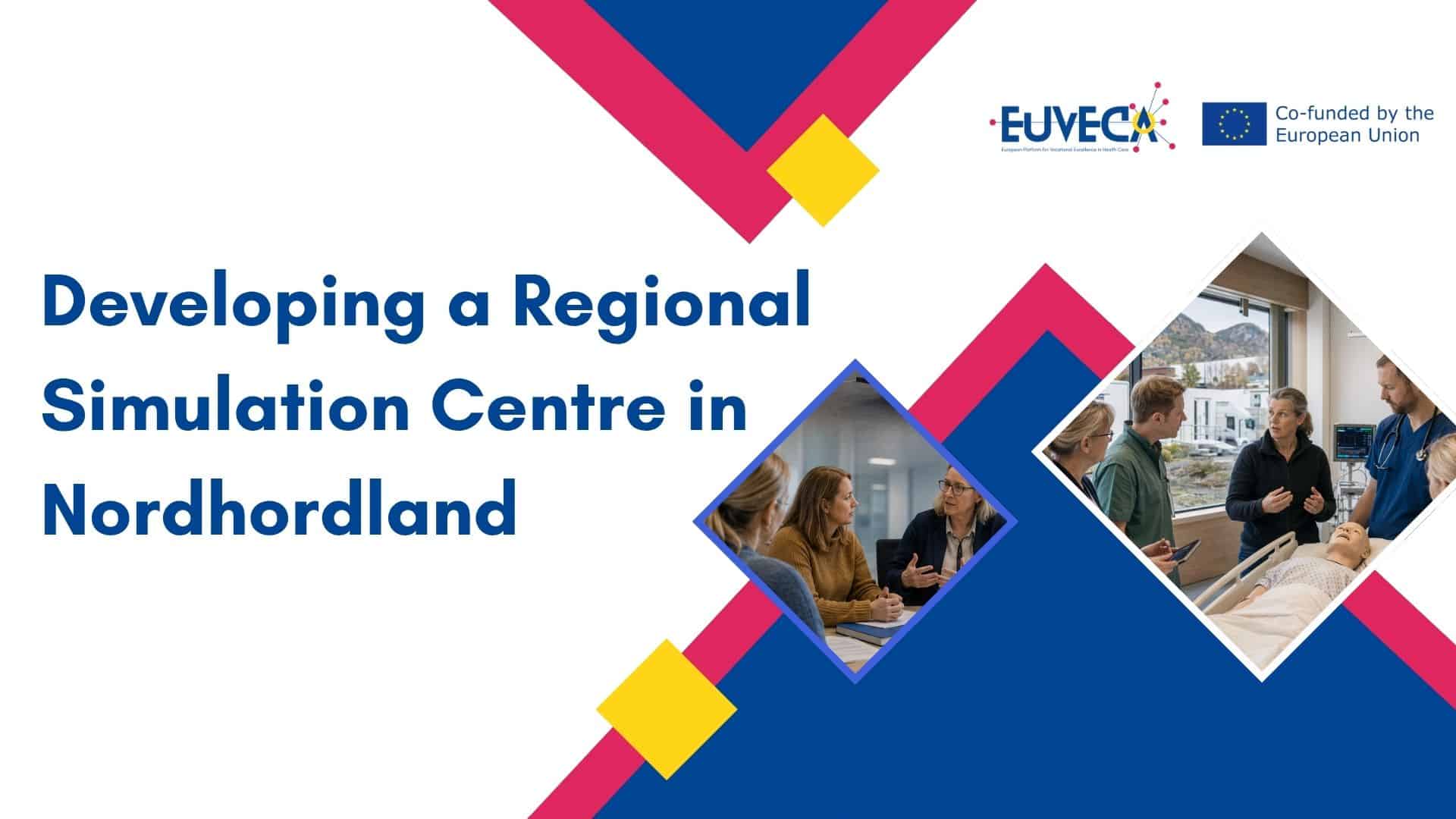
Through an established collaboration between municipalities, educational institutions, and regional professional environments, the Norwegian Hub is working to develop simulation as a regional resource. This work includes establishing a simulation centre in the district, continuing the use of the mobile simulation unit, collaborating with Western Norway University of Applied Sciences (HVL) through Artemis, and developing a community of practice within the SESAM network. Together, these initiatives will strengthen competence, collaboration, and sustainable service development across the region.
Developing Simulation in Practice
The Norwegian Hub is continuing its efforts to strengthen simulation as a method for learning, training, and quality improvement in health and care services. An important next step is to establish a simulation centre in the region that can serve as a permanent arena for simulation based training, professional development, and interdisciplinary collaboration. Such a centre will provide municipalities and partners with a more accessible and predictable offer for competence development close to where services are delivered.
At the same time, the Hub aims to continue the use of the mobile simulation unit. This mobile solution makes it possible to bring training and learning directly to the municipalities and workplaces where the needs arise. This is particularly important in rural areas, where distances can make it challenging to gather staff for regular training over time. By combining a permanent simulation centre with a mobile simulation unit, the region can develop both stable learning arenas and flexible training opportunities.
The collaboration with HVL through ARTEMIS (ARTEMIS | Alliance for Regional Transition, Equality, Mobilityn Inclusion and Sustainability) also creates new opportunities to connect practice, education, and professional development more closely. ARTEMIS is a European university alliance in which HVL is one of eight partner institutions, with a shared focus on regional development, mobility, inclusion, sustainability, and collaboration across education, research, and innovation. This aligns well with the work in Nordhordland, where simulation is being developed as a tool for competence building, interdisciplinary learning, and stronger links between services and educational environments. ARTEMIS also emphasises close cooperation with regional working life and society, which strengthens the relevance of simulation-based activities for municipalities and health and care services.
In addition, work is underway to establish a community of practice within the SESAM network. The aim is to build a broader regional and professional community for stakeholders working with simulation in primary care services. Through knowledge sharing, collaboration, and joint development, simulation can become more firmly anchored at the regional level and further developed as part of a larger network. This also reflects the broader ambition of ARTEMIS to strengthen collaboration, knowledge exchange, and capacity building across institutions and regions.
Key Takeaways
Taken together, these initiatives will help make simulation more regional, accessible, and sustainable. By developing both permanent and mobile solutions, strengthening collaboration with educational institutions, and building networks through SESAM and Artemis, the Norwegian Hub is laying the foundation for a more comprehensive and future-oriented development of simulation in the region.
Excerpt
The Norwegian Hub is working to establish a simulation centre in the district and to continue the use of the mobile simulation unit. Together with the Artemis collaboration with Western Norway University of Applied Sciences and a new community network within the SESAM network, this will help make simulation a regional resource that can be further developed within a broader professional network.
Follow our work on the EUVECA project website www.euveca.eu and on our European Learning Platform www.edu4health.eu.