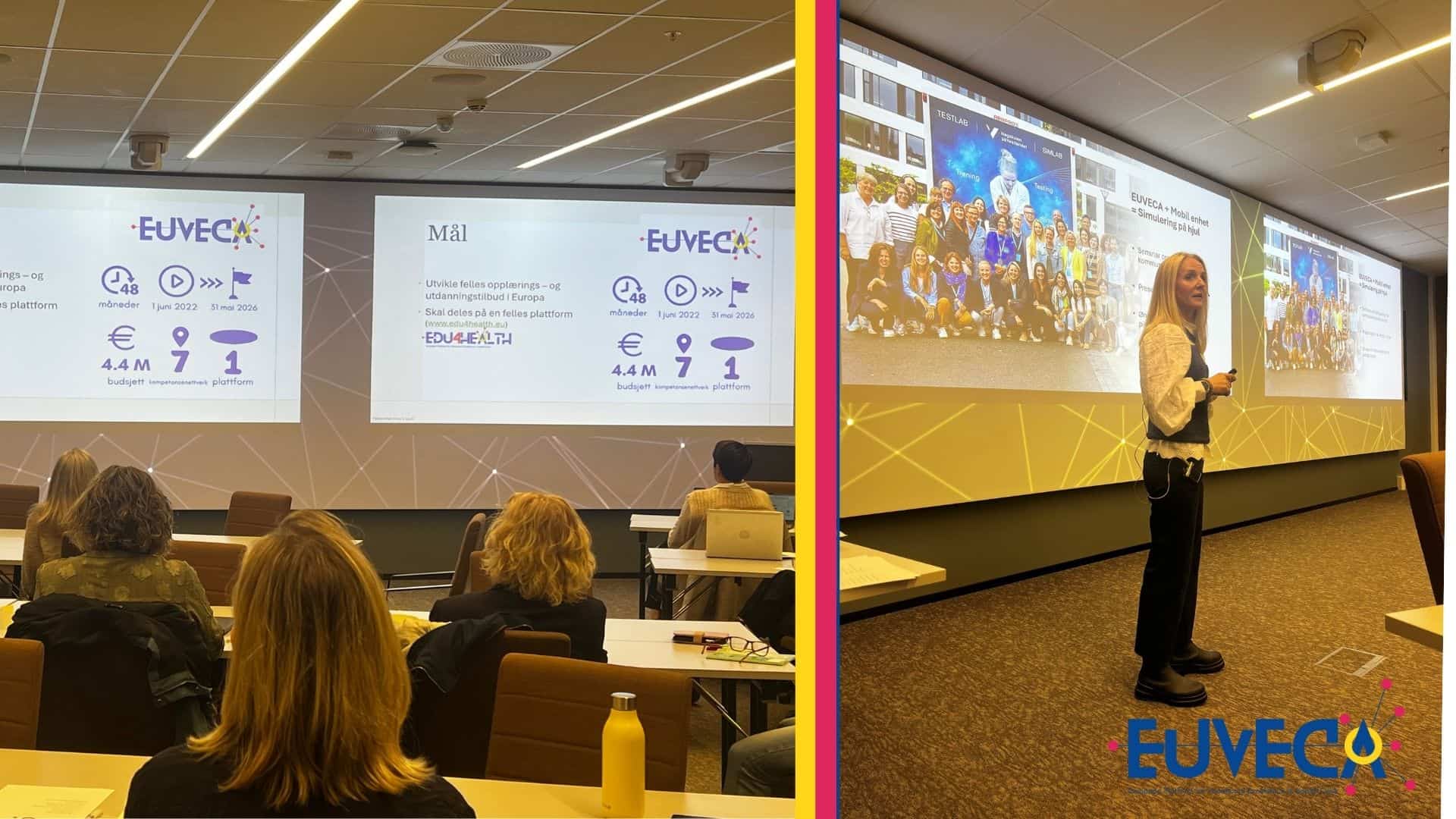
The recent EUVECA workshop in Nordhordland brought together leaders and professionals from municipalities, hospitals, and educational institutions to address shared challenges in health and social care. Through cross-sector dialogue, practical examples, and innovative approaches the event showcased how EUVECA partners are developing sustainable solutions for the future. This workshop is a model for interregional collaboration, demonstrating the power of partnerships in driving competence development and integrated care pathways across Europe.
Breaking Down Barriers in Health Care Through Collaboration
On October 22nd, the Norwegian EUVECA hub brought together a diverse group of stakeholders from Region Nordhordland IKS, Helse Bergen, and Western Norway University of Applied Sciences, along with municipal and educational leaders. There were in total 48 participants in the meeting. The aim of the workshop was to foster innovation, share experiences, and develop new models for workforce planning and competence development in health and social care services.
Important examples were presented:
- Task-Sharing and Practical Collaboration: Presentations from Helse Bergen and Alver municipality illustrated how smarter task-sharing and workforce planning can enhance efficiency and patient safety. These examples demonstrated that locally developed solutions can inspire broader regional improvements when shared in an open, collaborative forum.
- Innovation and mobility in Learning: The introduction of mobile simulation units and the Edu4Health platform is transforming access to training for health professionals and students. These tools make learning more accessible, flexible, and tailored to local needs, supporting lifelong learning and rapid upskilling.
- Integrated Care Pathways: The implementation of the Clinical Frailty Scale (CFS) across municipalities and hospitals illustrates how interregional projects can establish common standards and improve patient transitions across care levels.
After the presentations, interactive group work brought important discussions to address questions such as:
- How can we collaborate to address training and competence needs?
- How can tools like CFS support patient transitions?
- What does ideal collaboration look like in five years—and what steps must we take now
These sessions generated concrete ideas for future action, reinforcing that collaboration is not just a concept but a practical strategy for building sustainable health services.
A Model for the Future
The workshop concluded with a clear message: the journey towards better, more integrated health and social care services is ongoing, and collaboration – locally, regionally, and internationally – is key to success. The event provided both tools and motivation to continue working together across organizational and geographical boundaries.
Follow our work on the EUVECA project website www.euveca.eu and on our European Learning Platform www.edu4health.eu.