
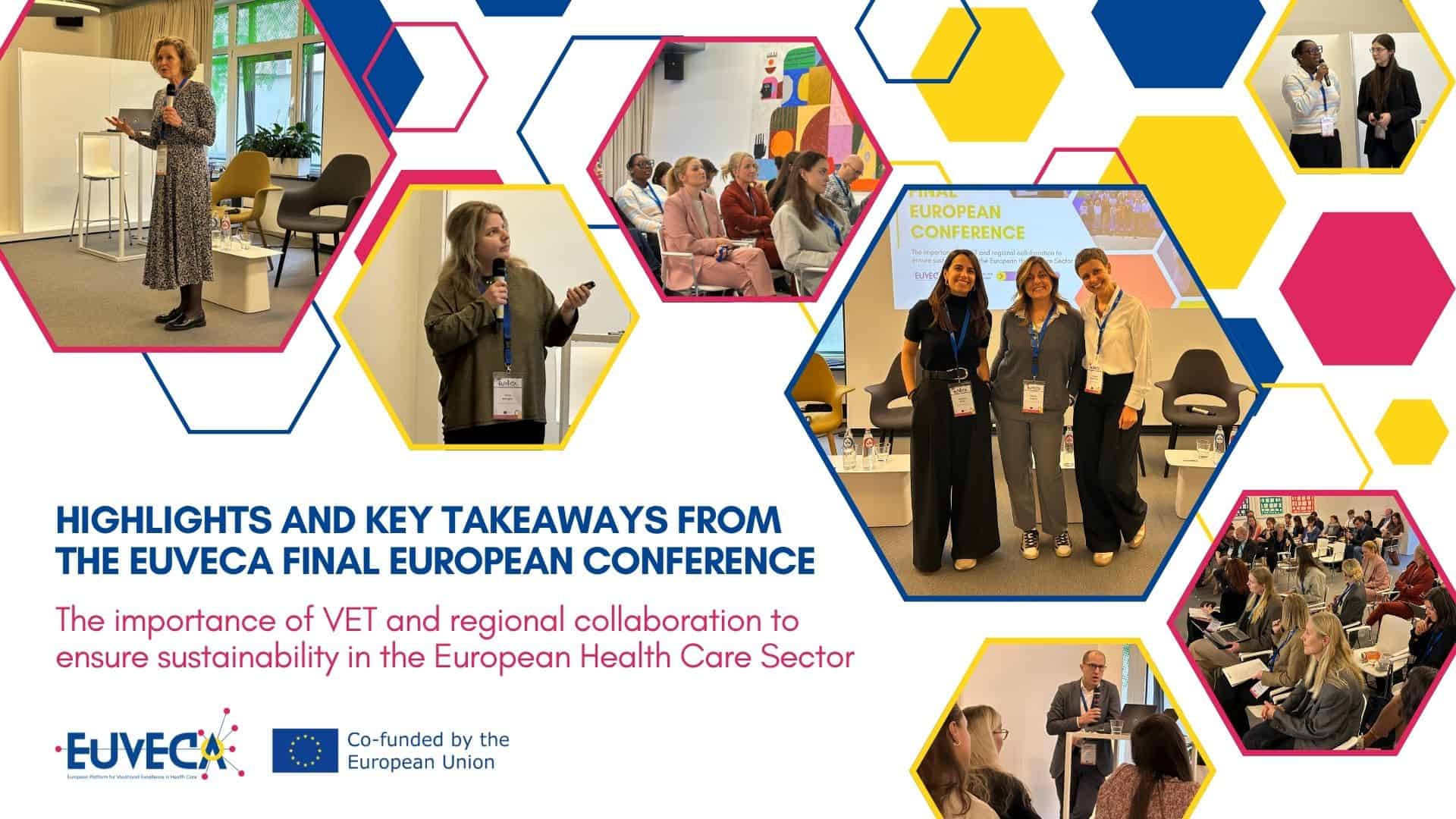
On 24 March 2026, the EUVECA Final European Conference on VET and sustainability took place in Brussels, bringing together policymakers, educators, healthcare professionals, and project partners to reflect on the outcomes of the EUVECA project and explore the future of vocational education and training (VET) in the health sector.
The conference provided a platform for exchange on how skills development, education systems, and regional collaboration can support a resilient and future-ready health workforce, particularly in the context of the green and digital transitions.
The event opened with remarks from the EUVECA project coordinators, followed by a contribution from Ms Hjørdis Vigarsdottir Dalsgaard (DG Employment, European Commission) on the future European VET strategy.
Session 1: From megatrends to skills needs and education
The first session explored how megatrends such as digitalisation, demographic change, and sustainability are reshaping skills requirements in healthcare.
The EUVECA baseline report highlighted the importance of communication and collaboration, while identifying gaps in ICT literacy, leadership, critical thinking, and green skills. Discussions emphasised the need to strengthen non-technical competencies and adapt training approaches through blended and simulation-based learning.
From a health management perspective, it was noted that while skills intelligence is increasingly available, translating it into practice remains a challenge. Stronger coordination between education providers, healthcare organisations, and regional ecosystems is needed to ensure effective implementation.
Student and professional perspectives further highlighted the importance of aligning curricula with real-world needs. While emerging topics such as digital health, sustainability, and personalised care are gaining visibility, gaps remain in their practical application and in the ability of health systems to fully utilise available competencies.
Session 2: Excellence in VET: the role of educators and innovation
The second session focused on the central role of educators in delivering high-quality health education.
Speakers highlighted ongoing fragmentation in nursing education across Europe, including variations in qualifications, curricula, and recognition frameworks. The need for common competence standards for educators, as well as strengthened European collaboration and continuous professional development, was emphasised.
Innovative learning approaches were also presented. The V-model for technology competencies demonstrated how structured and reflective learning can support the development of digital skills. In parallel, the use of virtual reality and simulation-based training illustrated how immersive and practice-oriented methods can enhance decision-making, teamwork, and patient safety.
These approaches show strong potential, while also requiring appropriate infrastructure, educator training, and integration into curricula to ensure sustainable impact.
Session 3: Regional and European collaboration in VET
The third session highlighted the importance of collaboration across regions and at European level to support effective skills development.
Speakers emphasised the need to move beyond fragmented initiatives towards more interconnected ecosystems, enabling stronger knowledge sharing, coordination, and scalability of successful approaches.
The role of regional and local authorities was underlined, particularly in shaping and implementing skills strategies aligned with European frameworks such as the Pact for Skills. Strengthening regional partnerships and improving coordination between EU initiatives were identified as key priorities.
A concrete example from the Autonomous Province of Trento demonstrated how long-term policy support, governance structures, and collaboration between public authorities, research organisations, and healthcare providers can create a strong and integrated health education ecosystem.
In addition, European projects such as Care About IT and XiA illustrated how targeted initiatives can contribute to developing digital and interoperability skills, while supporting the broader European Health Data Space and fostering a pan-European learning community.
Looking ahead
The EUVECA Final Conference highlighted that addressing skills needs in the health sector requires a coordinated and systemic approach.
While progress has been made in identifying future skills requirements, the discussions underscored the importance of moving towards implementatio, ensuring that education and training systems are aligned with labour market needs and that skills can be effectively applied in practice.
Strengthening collaboration between regions, education providers, healthcare organisations, and European initiatives will be essential to support a resilient, adaptable, and sustainable health workforce.
Follow our work on the EUVECA project website www.euveca.eu and on our European Learning Platform www.edu4health.eu.